Thursday, December 3, 2009

funny ethiopian carrying sheep while riding a bike

funny Ethiopian carrying sheepOne of the interesting things about being an Ethiopian is you get to do absolutely anything if you set your mind to it.

picture :
Hawassa city

Thursday, November 26, 2009

History of Laliballa

The legend of Lalibela
Ever since the first European to describe the rock churches of Lalibela, Francisco Alvarez, came to this holy city between 1521 and 1525, travellers have tried to put into words their experiences. Praising it as a “New Jerusalem”, a “New Golgotha”, the “Christian Citadel in the Mountains of Wondrous Ethiopia”. The inhabitants of the monastic township of Roha-Lalibela in Lasta, province of Wollo, dwelling in two storeyed circular huts with dry stonewalls, are unable to believe that the rock churches are entirely made by man. They ascribe their creation to one of the last kings of the Zagwe dynasty, Lalibela, who reigned about 1200 A.D.

The Zagwe dynasty had come to power in the eleventh century, one hundred years after Queen Judith, a ferocious woman warrior had led her tribes up from the Semyen mountains to destroy Axum, the capital of the ancient Ethiopian empire in the north.

The charming Ethiopian folklore pictures telling the story of King Solomon and the Queen of Sheba, which are sold in Addis Ababa, give a popular version of how not only the dynasty of ancient Axum (and present day Ethiopia) descended from King Solomon, but also the medieval Zagwe dynasty. The Queen of Sheba gave birth to Menelik, who became the first King of Ethiopia. But the handmaid of the Queen, too, gave birth to a son whose father was King Solomon, and her son was the ancestor of the Zagwe dynasty.

The Zagwe kings ruled until the thirteenth century, when a famous priest, Tekla Haymanot, persuaded them to abdicate in favour of a descendant of the old Axumite Solomonic dynasty.

However, according to legend before the throne of Ethiopia was restored to its rightful rulers, upon command of God and with the help of angels, Lalibela’s pious zeal converted the royal residence of the Zagwe in the town of Roha in to a prayer of stone.

The Ethiopian Church later canonized him and changed the name of Roha to Lalibela. Roha, the centre of worldly might, became Lalibela the holy city; pilgrims to Lalibela shared the same blessings as pilgrims to Jerusalem, while the focus of political power drifted to the south, to the region of Shoa. Legends flower in Lalibela, and it is also according to legend that Lalibela grew up in Roha, where his brother was king. It is said that bees prophesied his future greatness, social advance and coming riches. The king, made jealous by these prophecies about his brother tried to poison him, but the poison merely cast Lalibela into a death like sleep for three days. During these three days an angel carried his soul to heaven to show him the churches which he was to build. Returned once more to earth he withdrew into the wilderness then took a wife upon God’s command with the name of Maskal Kebra (Exalted Cross) and flew with an angel to Jerusalem. Christ himself ordered the king to abdicate in favour of Lalibela. Anointed king under the throne name Gare Maskal (Servant of the Cross) Lalibela, living himself an even more severe monastic life than before, carried out the construction of the churches. Angels worked side by side with the stone masons, and within twenty four years the entire work was completed.


Rock hewn churches
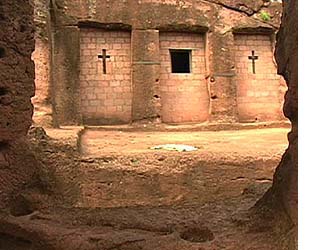
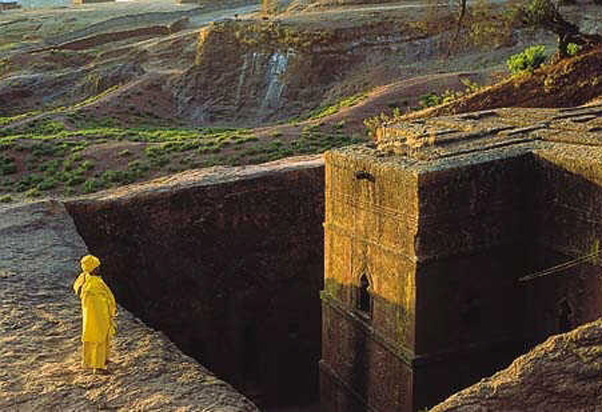
Walking through the village you will see the mountainous landscape of the region of Lasta, where the peasants labour to cultivate their patches of stony fields with the traditional hook-plough. Strolling across a gently undulating meadow, you will suddenly discover in a pit below you a mighty rock - carefully chiselled and shaped -the first rock church. None of these monuments of Christian faith presents itself to the visitor on top of a mountain as a glorious symbol of Christ’s victory, to be seen from far away by the masses of pilgrims on their road to the 'Holy City', they rather hide themselves in the rock, surrounded by their deep trenches, only to be discovered by the visitor when standing very close on top of the rock and looking downwards.

In Lalibela itself you will find two main groups of churches, one on each side of the river Jordan and one other church set apart from the rest. The town of Roha-Lalibela lies between the first and the second group of churches. It is situated on the higher part of a mountain-terrace on a vast plateau of rock. At Timkat (Ethiopian Epiphany. ca. January 19) a vivid ritual unfolds before the spectator: here the dances of the priests take place after the annual repetition of mass baptism in the river Jordan.

There are twelve churches and chapels, including various shrines. Four churches are monolithic in the strict sense; the remainder are excavated churches in different degrees of separation from the rock. The walls of the trenches and courtyards contain cavities and chambers sometimes filled with the mummies of pious monks and pilgrims.

Types of Churches
There are three basic types of rock churches in Ethiopia:
1. Built-up cave churches, which are ordinary structures inside a natural cave (Makina Medhane Alem and Yemrehanna Krestos near Lalibela are examples of this style).
2. Rock-hewn cave churches, which are cut inwards from a more or less vertical cliff face sometimes using and widening an existing natural cave (Abba Libanos in Lalibela).
3. Rock-hewn monolithic churches, which imitate a built- up structure but are cut in one piece from the rock and separated from it all round by a trench. Most churches of this type are found in or near Lalibela (Bet Medhane Alem. Bet Maryam. Bet Giorgis, and others). Nowhere else in the world are constructions of this particular kind found.

There are some fairly obvious technical details to prove the high standard of technical knowledge the architects of Lalibela must have had: the churches in a group are set on several levels, in order to carry off the heavy summer rains. The trenches serve also as a drainage system to the river Jordan. With churches whose placing conforms to the slope of the terrain, the ridge of the roof, gutter edges, the base of the plinth, are slanted in line with it.

Whoever has experienced the "rainy season" in Ethiopia will appreciate the great skill shown by these early builders. The rains are so heavy that Lalibela is inaccessible in the rainy season; landing at the airport as well as an approach by Land-Rover from the main road are impossible.

Authorities claim that the rock churches in Ethiopia have two roots:

(1) the Axumite architecture with its palaces of wood and stone construction and with its monolithic stelae, and
(2) the early Christian basilica.

The rock churches reflect the blending of Axumite tradition and early eastern Mediterranean Christianity: Yet they are an entirely new creation of early Christian art on Ethiopian soil.

The First Group of Churches
The churches of the first main group lie in their rock cradles one behind the other north of the river Jordan. The original approach might well have been from the river Jordan up to the churches Golgota-Debre Sina (Mika'el) in the west. The whole complex, seen in an east-westerly direction, may be divided into three smaller groups:
Bet Medhane Alem in the east, the Bet Maryam group in the centre, and the twin church Golgota- Debre Sina (Mika'el) with the Selassie Chapel in the west.
While each sub-group has a courtyard of its own, the whole complex is surrounded by a deep outer trench.

Bet Medhane Alem
Approaching the most eastern church of this group, Bet Medhane Alem (House of the Redeemer of the World) , you first catch a glimpse of the roof, decorated with relief crosses connected by blind arcades, and the upper part of the solemn colonnade surrounding the church: The roof still shows traces of the plaster remains of the restoration efforts of the early 1930's. The tuff, from which the church is carved, glows a typical deep pink colour in striking contrast to the brownish-yellow earth and green-leaved trees of the landscape. Standing in the courtyard you face the largest of the rock-hewn churches.
It has been cut free from a block of stone 33.7 m. in length, 23.7 m. in width and 11.5 m. in height. It is a noble structure, standing on its plinth with its pitched roof and surrounding external columns, somewhat reminiscent of ancient Greek temple architecture.

Exterior
The low-pitched saddle-backed roof lies directly on the order of columns, so that there is no entablature as there would be in a Greek temple. A frieze of round arches in relief decorates the vertical edges of the roof. The gallery running round the four sides of the church between the colonnade and the outer wall of the church itself is only 70 cm wide. While most of the slender pillars, which are square in cross-section, are still the original ones some of them had collapsed and have had to be replaced by new built-up structures. Note the fine sarcelly cross relief on the slabs of stone which connect the four corner pillars with adjacent pillars about two thirds of the way up. Traditional sarcelly crosses like the ones seen here have been copied in modern buildings in Addis Ababa, e.g., the entrance pillar stumps of the Municipality.

Interior
Around the high walls of the nave runs a frieze of blind windows framed by protruding beams at each corner. Along the sides, the windows are either blind windows with decorations or actual openings between the "galleries" and the nave. The "galleries" can be reached from a cell to the left of the narthex. The doorways inside again exhibit Axumite framework style.

One particular pillar in the centre is covered with a cloth. This is the "amd" - the symbol of the unity of faith. The priests explain that Christ touched the pillar when appearing to King Lalibela in one of his visions. Since that time the past and the future of the world are written on it. Since man is too weak to bear the truth revealed by God the pillar is covered.

In the nave the shafts, capitals and corbels of the columns and pilasters as well as the arches are carved in bas-relief some of them painted. There is a great variety of crosses.
Paintings proper can be found on the spandrels, the string-courses above the arches, the area of friezes of the blind windows and the barrel vault.

Bet Maskal
The chapel of Bet Maskal(The House Of The Cross) has been excavated in a bulge in the northern wall of the Bet Maryam courtyard. It is a broad gallery of 11 m. length and 3.4 m. width. A row of four pillars divides the space into two aisles spanned by arcades. The doorways show imitation of monkey-head framework. Beams of light deflect downwards into the chapel from two windows, one of them having a swastika design through which is pierced a Greek cross, while the sanctuary window opening has a Maltese cross motif. A frieze of arches between two projecting horizontal courses finishes the facade on top.

Bet Danaghel
Bet Danaghel (The House Of The Virgins Or Martyrs). Jutting out at the south of the Bet Maryam courtyard is the little chapel of Bet Danaghel (8.6 m. length and 3.6 m. height). This tiny chapel is connected with one of the most fascinating legends of Lalibela. Priests will tell you that the chapel was constructed in honour of maidens martyred under Julian. The memorial day of the maidens is the 10th of Hedar (November) in the Ethiopian calendar.

Located just outside the southern wall of the courtyard proper is the twentieth century memorial to Ras Kassa Darge. Ras Kassa was the governor of central and northwestern Ethiopia, prior to the Italian occupation. He died in 1956.

Bet Debre Sina and Bet Golgota with the Selassie Chapel and the Tomb of Adam
This is the most mysterious complex in Lalibela, housing its holiest shrine, the Selassie Chapel, and according to the whispers of the priests - perhaps even the tomb of King Lalibela himself. While the ancient entrance to this group was probably from the west, passing the hollowed block of the Tomb of Adam, the courtyard is now entered from the south, being connected by the trench leading to the Bet Maryam churches. A side door leads to the first church, Bet Debre Sina or Bet Mika'el.

Bet Debre Sina
Bet Debre Sina(House Of Mt. Sinai) displays a proper east-west orientation and has a raised chancel. The holy of holies is in the east. Thus, we may assume that it has always been an independent and separate church. It is a semi-monolithic creation measuring 9.5 X 8.5 m. and resting on a steep plinth 3 m in height. On three sides it is exposed by excavation to a trench, the northern side leading to Bet Golgota.

Exterior
The exterior walls are smooth, with two rows of windows. In the bottom row of the south facade there are window openings in the shape of key-holes.

Interior
The interior is simple and solemn in atmosphere. It is divided by pillars into a nave and two aisles with five bays each. Round arches connect the pillars and pilasters in the walls. Cruciform in section, the pillars support round arches; their pseudo-capitals are decorated with Greek crosses in relief, which are also found on the blind arches and on the ceiling.

Bet Golgota
Leaving Bet Debre Sina you enter its northern twin church, Bet Golgota (The House Of Golgotha). Bet Golgota represents the type of excavated church with one worked facade (the west face).

Exterior
The facade is smooth and scantily decorated. Piercings are functional, providing the church with light and air. A few protruding beams frame the uppermost windows, while the lower ones, semicircular and cruciform in shape display a few mouldings only
Yet there are two harmoniously designed window openings in the southern wall which give light to two shrines, the one on the left to the "lyasus-Cell" (Cell of Jesus) of Bet GoIgota; the right-hand one to the Selassie Chapel.

Interior
Entering the church proper you will find that it is divided into two "naves" by three cruciform pillars that display no decoration apart from the usual corbels. Flattened arches connect the pillars with the corresponding pilasters at the wall.
The "Iyasus-Cell" at the east end of the right-hand nave and the "tomb of Christ", an arched recess in the northeast corner of the church, add an air of sanctity. The church with the name of Golgota is dedicated to the passion and Death of the Saviour.

The church, simple in its architecture, houses, however, some of the most remarkable pieces of early Christian Ethiopian art: figurative relieves, rare elsewhere in Ethiopia. The "tomb of Christ" displays behind a wrought-iron grille a recumbent figure in high-relief with an angel in low-relief above its head. The figures of seven saints, mostly larger than life, decorate arched niches in the walls.

The Selassie Chapel
From Bet Golgota a doorway at the east end of the right-hand nave next of the one leading to the "Iyasus-Cell" opens on to the Selassie Chapel - the place of greatest sanctity in Lalibela.
A curtain covering two thirds of the wall will offer you only a glimpse inside the shrine. The ribs decorating the ceiling in the shape of a cross might also be discernible. This holy place is rarely open even to the priests themselves, and very few visitors have been permitted to enter it.
The shrine is completely imprisoned in the rock. A single pillar supports the roof with its barrel-vault in the rear section and flat-arch above the platform with the three monolithic altars. This pillar, which has no base, rises up more than five metres to the apex of the vault.

The Tomb of Adam
Impressive in its simplicity, a huge square block of stone stands in a deep trench in front of the western face of Bet Golgota. This is the Tomb of Adam. The block has been hollowed out, the ground floor serving as the western entrance to the first group of churches. The upper floor houses a hermit's cell. Again it is a cross that is the only decoration of this "tomb ". The large opening in the eastern wall provides light for the cell and has the shape of a harmonious croix pattee with flat-pitched finials.

The Second Group of Churches
This second group comprises from east to west, the churches and sanctuaries of Bet Emanuel, Bet Mercurios, Bet Abba Libanos, the Chapel of Bet Lehem and Bet Gabriel-Rufa'el.
Approaching the town of Roha-Lalibela from the south, you will see, south of the river Jordan, a bastion of red tuff severed from the rock plateau in the north, east and south by a broad artificial outer trench, eleven metres deep. Another deep central trench cuts this area into two parts, leaving at its end a cone-shaped hill. An old entrance led from this central trench to the sanctuaries mainly by way of narrow subterranean passages. The 'Original function of this complex of churches has not yet been clarified. Two of them were certainly planned as such, Bet Emanuel and Bet Abba Libanos. They have a proper church plan and are oriented to the east.

Bet Emanuel
Art historians consider Bet Emanuel to be the finest and most impressive church in Lalibela. Looked at from above, its mighty, flat- pitched roof can be seen glistening from the rock cradle that houses the church. It is the only true monolithic structure of this group, carefully sculptured from a block 18 X 12 X 12 m. The church offers an almost classic example of Axumite style despite the fact that the floor and side plans follow the true basilica pattern with a proper east-west orientation.

Exterior
Entering the courtyard you will see this fascinating church on its stepped platform shining in the bright red colour of the Lalibela tuff. The imitation of Axumite wood and stone construction is striking, its walls built in horizontal and vertical bands, alternately recessed and projecting. At the three entrances, in front of which the stepped platform widens into landings, the church has a framework of protruding beams; genuine monkey-heads are missing. There are three rows of windows, the bottom and top ones having frames with corner posts. The bottom windows are pierced in that shape of straight Greek crosses; those in the top row have no fillings.

Interior
Inside you will find the true basilica plan: aisles and a mighty vaulted nave. Yet Axumite style is here again: the in- dentations in the outside walls, in which all the doors and windows are placed, reflect the internal division, as do the mouldings, the number of aisles and bays, the position of the galleries and the height of the vault. In the hall there are four complete and four three-sided pillars. A rock staircase leads from a side room by the main entrance to a second storey, here little rock chambers surround the hall. The striking interior feature is the double frieze of blind windows in the vaulted nave, the lower frieze being purely ornamental, the upper one consisting of windows alternating with decorated areas. In the rock floor of the southern aisle a hole opens into a long, subterranean tunnel leading to neighbouring Bet Mercurios.
Chambers and cavities for sacred bees in the outer wall of the courtyard are reminder of the bees that prophesied kingship to Lalibela. Some of the chambers, however, are the graves of monks and pilgrims who wanted to be buried in the "holy city. In this outer wall two further underground passages have been discovered leading to Bet Mercurios.


Bet Mercurios
The church is neither orientated nor conventionally planned. The part serving today as a church occupies the eastern end of a subterranean hall which opens to a courtyard. The interior appears to be void of decoration although there is a fine mural on the lower pan of a pillar, depicting six kings or saints in royal apparel, holding in their hands beautifully shaped hand- crosses, reminiscent of late Gondarene processional crosses.

Rich paintings once adorned the church but for preservation they have been removed and are now to be seen in the National Museum in Addis Ababa.

Bet Abba Libanos
Lalibela's wife, Maskal Kebra, with the help of angels, is said to have created this church in one night. It is dedicated to one of the most famous monastic saints of the Ethiopian Church, Abba Libanos.

Bet Abba Libanos (The House Of Abba Ubanos)
Exterior
The facade is reminiscent of Axumite architecture, although here - unlike Bet Emanuel - the horizontal bands are missing. It is a good example of a cave church. The roof is not separated from the rock, but the other three sides are detached by a tunnel.

Interior
The aisles and the nave of the church run exactly from east to west. The priests will tell you that there is a "little light'; in the middle of the altar-wall shining day and night "by its own power: Conjectures by visitors run from "a piece of phosphorescent stone" to "a hole in the wall" trying to give a more "natural" explanation and at the same time robbing the phenomenon" of the charm of its mystery.

Bet Lehem (The Chapel Of Bethlehem)
You may reach Bet Lehem by a passageway 50 m. long that starts at the right-hand aisle of Bet Emanuel, and passes Bet Mercurios and the courtyard of Abba Libanos. The shrine has been shaped into a cone by the central trench: the tunnel still winds up in spiral form within the hill and ends in a low, round room. A tree-trunk in the room serves as a central pillar.
The original function of this shrine is not known. Visitors may not be allowed to enter the interior of Bet Lehem.

Bet Gabriel-Rufa'el (The House of Gabriel And Raphael Or The House of the Archangels)
Bet Gabriel-Rufa’el (The House Of Gabriel And Raphael Or The House Of The Archangels). This church is more difficult to describe in character and situation than the others. Its disorientation and unusual plan suggest that it was originally not intended to serve as a church. Instead, the floor plan is labyrinthine: three angular halls with pillars and pilasters are squeezed between two courtyards. The most impressive part of the church is the monumental facade.
The church is usually entered from the top of the rock near Bet Emanuel in the east, by a small bridge of logs leading over the central trench.
You may also approach from the east by a series of small tunnels, a gallery like passage and another log bridge 10 m, above the courtyard.
The triangular floor of the northern courtyard is enclosed by walls whence, high up, the facade of the church and the gallery opposite can be seen. Down in the courtyard there is a well and an underground cistern. Steps lead down to a subterranean hall of pillars, where the water sinks or rises, according to the dry and rainy seasons.

Exterior
The monumental front of the church can only be properly examined from the opposite gallery in the north. This truly royal façade is another example of a survival of the Axumite style; pilasters and niches give the impression of breaking the line of the wall into projections and the niches themselves.

Interior
The interior of the church, which is far smaller than the exterior suggests, is carefully hollowed out forming a hall divided by pillars. Three straight Latin crosses are incised into the wall, the only decoration discernible.
The floor in the church has a number of partly covered holes of various sizes which are said to go down to great depth. Drains run across the floor and little grooves surround the holes.

Bet Giorgis

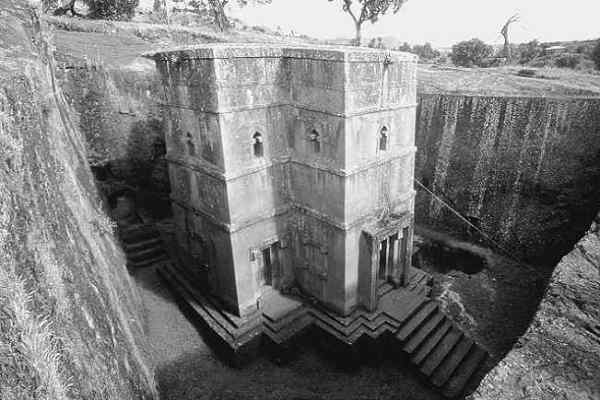
The monolithic Bet Giorgis - dedicated to the national saint of Ethiopia is isolated from the other two groups of churches. It is located in the southwest of the village on a sloping rock terrace. In its deep pit with perpendicular walls it can only be reached through a tunnel which is entered from some distance away through a trench. Small round caves and chambers have been found in the walls of the courtyard graves for pious pilgrims and monks.

The church is described as Lalibela's "most elegant" and "refined" in its architecture and stonemasonry. Although its floor plan is of a cross with nearly equal arms the church is properly orientated, the main entrance being in the west, the holy of holies in the east.

Exterior
Like a tower the cruciform church cut out of the pink tuff rises from its triple-stepped platform, the regularity of which is broken only by the landings in front of the three doorways in the west, north and south. The roof decoration, often represented as the symbol of the Lalibela monuments on photographs and postcards, is a relief of three equilateral Greek crosses inside each other. On the north, south and west sides, gutters and spouts drain the water from the roof.

One of the more sophisticated details of Bet Giorgis is that the wall thickness increases step by step downwards but that the increase is cleverly hidden by the horizontal bands of mouldings on the exterior walls.

Interior
Despite the orientation you will find that the interior of the church follows the cruciform floor plan of the church. There are no genuine pillars; instead four three-sided pilasters with. corbels support the arches. The dome above the sanctuary in the eastern arm of the church is decorated with a croix pattee in relief, while the flat ceiling of the other arms display a straight relief cross: The ceiling of the intersection is left without decoration.

Other Churches Near Lalibela
There are several other churches in the vicinity :
the churches of the Bilbala district, including the beautiful built up cave church of Yemrehanna Krestos, the tiny rock church Arbatu Entzessa, Bilbala Gioris and Bilbala Cherqos. Also the church of Sarsana Mika'el.

Yemrehanna Krestos
This remarkable church is located six hours by foot and mule to the northeast of Lalibela, on the mountain ridge the peak of which is Abuna Yosef. It is a built-up cave church in Axumite wood and stone construction. The church has become famous for the decoration of its interior. The flat-span roof displays paneling richly adorned with .geometrical designs. The ceiling over the sanctuary is domed and displays carvings and paintings. The founder of the church is said to have been King Yemrehanna Krestos, a predecessor of King Lalibela.

Arbatu Entzessa
can be reached from Yemrehanna Krestos proceeding to the southwest. This tiny monolithic sanctuary is detached from the surrounding rock on two sides. It shows remains of old ornaments; pillars, capitals and doors are chiselled in Axumite style. The name suggests that the church is dedicated to the "four beasts", symbols of the Four Evangelists following the vision of St. John. The Ethiopian synaxarium dedicates the 8th of Hedar (November) to these four beasts.

Bilbala. Giorgis
Proceeding from Arbatu Entzessa to the west you find Bilbala Giorgis, of which only the facade is visible. The other sides are surrounded by a tunnel: the roof is not separated from the rock. A frieze with emblems of the vault of heaven decorates the facade. Legend says that holy bees live under the roof rock in niches.

Bilbala Cherqos
Bilbala Cherqos. West of Bilbala Giorgis is this semi-monolithic church, one day's travel by mule to the northwest of Lalibela. The church is properly orientated and has been worked from a piece tuff from east to west. The careful stone masonry on the facade is reminiscent of the facade of Bet Gabriel-Rufa'el.

Sarsana Mikaél
The tiny monolithic church lies in a grove of euphorbia trees in the Sarsana plains and is scarcely visible in its bed of rock. Through a passage you reach a deep trench running round the church. Three sides are exposed revealing influences of the Axumite style.

Crosses In Lalibela
The two basic types are the Greek cross, which has equal straight arms, and the Latin cross, which has straight arms with the inferior one longer than the other three. These have been developed into a great number of very elaborate and artistic designs.
The favourite form in Ethiopia is the croix pattee -a Greek cross with flaring arms - and its rich variations.
In the Zagwe sphere a special kind of elongated processional cross has been developed.
Lalibela crosses very often have bird heads at the sides and have a crown of stylized human figures as symbols of the twelve apostles; the finial cross then represents Christ. Birds (doves) are often depicted together with the cross.
The swastika shapes found in Lalibela should not be confused with the old sun symbol found for example in Europe and in India. The Lalibela swastikas were developed from the Greek cross with bent arms and were often combined to form interwoven patterns as was the case in Christian art and in the Middle Ages.
The priests have developed a rich symbolism, every pattern having a different meaning. Three- tipped crosses refer to the Trinity; five incised circles or indentations represent the wounds of Christ. However, these decorative patterns often are interpreted differently according to the schooling of the individual priest.

Must see Places in Ethiopia . Visit Ethiopia

If you are on your way to Ethiopia soon , I have gathered some information so that you can have a good time , if you haven't read the "Guide to Ethiopia " article , i recommended you take a look at it .

first place is always the capital,so literally if you took a flight its where you are going to land :) .

Addis Ababa:

Africa Hall - The Africa Hall is situated opposite the Grand Palace. It has been the seat of the United Nations Economic Commission for Africa. The first African Heads of State Conference, which brought the Organization of African Unity (OAU) into being currently called (AU..african union ), was held in this building in 1963. Inside you will find one of the finest works of Afework Tekle, depicting the Africans of yesterday, today and tomorrow in their struggle for freedom and progress.


Menelik museum - Menelik Mausoleum is situated in the enclaves of the old palace under Batta Church. It was built in 1911 and houses the crypts of Emperor Menelik II, his wife, Empress Taitu and his daughter, Empress Zauditu. The mausoleum also yields numerous parchments, scrolls and other vernacular scripts.

Mercato - This is largest open market in all of Africa and one of the largest in the world. Everything one can think of (and we mean everything) is bought and sold in Mercato. It is a sight definitely worth seeing.

Mount Entoto - Mount Entoto is the best location to observe the panoramic view of Addis Ababa both by day and night. On top of this hill stands St. Mary's Church built in 1885.

National Museum - The National Museum is situated within the old palace, which is now Addis Ababa University. The museum contains numerous antiquities, various historical relics, archaeological, paleontologist objects including the 3.5 million-year-old skeleton of Dinkenesh (Lucy).

Trinity Cathedral - Trinity Cathedral was built in 1941. It is the largest and most magnificent of all modern churches in the country ornamented with carvings, mosaics, and other artistic works including stained glass paintings of saints and apostles.
Ambo & Guder:

Ambo is situated 125Km West of Addis Ababa. The Ambo road passes through Geferssa Reservoir, thereafter Mengesha and Addis Alem towns. Ambo yields the most popular mineral water source. Its hot springs have been turned into modern spas. After a few minutes drive, the town of Guder can be reached. Here, the beautiful volcanic Crater Lake of Wonchi, the spectacular Guder Falls, and its vineyards can be seen. Guder, a popular export quality red wine has been named after this town.


Arba Minch:

Arba Minch is well known for its large number and variety of wildlife, species endemic birds and natural beauty of the landscape. Drive Southeast of Addis Ababa passing through Debre Zeit and continue driving along the main road of the Great Rift Valley which leads you to the South along the shores of many of the lakes.


Awash National Park:

Awash National Park and Game Reserve is situated 225Km Southeast of Addis Ababa. There is a signboard around the park to indicate the boundary. It is advisable to drive down towards the Awash River first, which constitutes the Southern boundary of the park. Here, one can observe the Awash falls, the gigantic gorge, palm tree hot springs and species of wild animals like oryx, hartebeest, water kudu, lion and gazelle.

Bahar Dar and The Blue Nile:

Bahar Dar is a small commercial town situated on the Southern tip of Lake Tana. The Blue Nile Falls is about 30Km from the town. (The Blue Nile Gorge itself is situated 130Km North of Addis Ababa). The majestic and enormous gorge has a magnificent and alluring physical feature and natural beauty. The source of the Blue Nile is Lake Tana. The lake provides access to about 30 islands which house many island monasteries. While touring this area, it is worth your time to stop by and see the Waito craftsmen constructing Papyrus boats in the nearby Fogera area.


Debre Berhan & Ankober:

Debre Berhan is situated 130Km Northeast of Addis Ababa. It is one of the oldest towns in the country. This town is the center of many institutions and factories. Above all, it is famous for its wool-processing factory. The city also has several historical sites in it. One such historic place is the Sellassie Monastery. Ankober is a small town 35Km South of Debre Berhan, where Emperor Menelik was born. It is situated on top of a great escarpment. There, we find the ruins of Menelik's palace still standing near St. Michael's Church.


Debre Libanos:

Debre Libanos is 100Km North of Addis Ababa and on a 13th monastery is found here. Nearby lie the great Jema Gorge and the Portuguese Bridge, which was built in the 16th Century and is still in use. The monastic community of Debre Libanos annually receives thousands of people who travel to this holy place on pilgrimage.


Debre Zeit:

Debre Zeit (also known as Bishoftu) is 45Km Southeast of Addis Ababa. Attractive and lovely crater lakes, ideal for bird watching and boat ride, surround this town.


Gonder:

Gonder was once the capital city of Ethiopia. During the reign of Emperor Fasiledes and his predecessors from the seventeenth century onwards. This city is known for its ancient cities and castles. It also has several monasteries such as Quesquam.


Lalibela:

Lalibela is a small town which is secluded by mountains. It is named for the famous Zagwe Emperor, Lalibela, who reigned in the 13th century. (Click here to learn more about the Zagwe Dynasty). This is the place where you can find the elevan rock-hewn churches of the 13th century, carved out of single, solid rocks. Lalibela is considered as the "second Jerusalem" by most Ethiopians.


Langano:

Langano is located 200Km South of Addis Ababa. It is a sand beach that attracts many visitors. Along the road to Langano, one can see beautiful landscapes. As you continue driving, the first lake to be seen among the rift valley lakes is Lake Zeway. It is a shelter for a variety of birds and fish. Proceeding further to the South, Lake Abiyata and Lake Shala can be reached. These lakes are breeding places for Flamingos and ideal for bird watching. Nearby is lake Langano, a resort area and a paradise for holidaymakers. Traditions for most vacationers include setting up tents along the beach, eating (fresh-meat) barbeque.


Menagesha Forest:

Mengesha Forest is about 35Km West of Addis Ababa. The park is densely wooded with 400 year old trees. In this park, you can find species of various birds and animals, such as the Menelik Bush Buck and the Black & Blue Wind Goose.


Sodere:

Sodere is situated 126Km Southeast of Addis Ababa. It is a very popular resort area with new hotel complexes. The Olympic size pool and physiotherapy centers are frequented by visitors of all ages. The vegetation of Sodere and its vicinity is evergreen, healthy and scenic. Nearby, the Awash River meanders through the forest that forms giant shade trees.

Wednesday, November 25, 2009

Monday, November 23, 2009

Guid to Visiting Ethiopia .

YOUR TOUR GUIDE
Tours guides have been carefully selected and specially trained in the skills that assure a rewarding, enjoyable trip. They are knowledgeable, understanding and devoted to making this a relaxing and memorable tour. They supervise the handling of luggage, take care of check-in and departure from hotels, reconfirm included meals, and brief you on the daily events and timetables during the tour. He or she will do all that is possible to accommodate you.

LUGGAGE INFORMATION
You are welcome to bring a normal-sized suitcase as well as a small carry-on bag. The handling of the normal-sized suitcase will be our responsibility while moving from place to place duiring the tour and the carry-on will be yours. Your Tour guide or bell man will arrange for the suitcases to get to your room. On travel days, your Tour Manager will give you the time your bag should be available for pick-up by the bell man.
PLEASE REMEMBER TO PACK ANY MEDICATION IN YOUR CARRY-ON OR CARRY IT WITH YOU.
Note: If your tour is a flight one, airlines have strict regulations concerning luggage weight allowance. You may be asked to pay an additional fee at the airport if your luggage weight exceeds 25kg.

INCIDENTAL CHARGES
While staying at your lodging, costs you incur for phone calls, room service, laundry, and other special services are your responsibility. Please take care of these charges as soon as possible, either the night before or on the morning of departure, being mindful that your tour’s departure is not delayed.

TIPS ON TIPPING
When people go out of their way to do their best, providing extra service with a smile, you like to reward them for a job well done. Since most people would like to say a special “thank you” to their Tour guide and driver, may we suggest the following guidelines: (especially if the group is comprised of five to twelve people ) A gratuity of $3 to $5 per person per day for your Tour guide ; $2 per person per day for your driver. These individuals are with you throughout the entire tour, so please use your own judgment and tip according to services rendered. Please handle this on an individual basis – the best way to present this gratuity is in an envelope with your name on it. We request that group collections not be taken.

VISAS
Citizens of 33 countries can now get visas on arrival, visitors from other countries should obtain visas from the Ethiopian Embassy in the their country of residence. If there is no Ethiopian Embassy, arrangements can be made through tour operators to obtain one on arrival at the airport.

AIRPORT SECURITY
Travelers are required to have an airline-issued boarding pass while checking in for flight from one city to the other. Travelers are also subject to searches at security checkpoints.

AIRPORT TAX
There is a US$20 departure tax for international flights

TRANSPORTATION INFORMATION
No matter what tour you are traveling on, we do all we can to make your trip rewarding and enjoyable. All of our motorcoaches, mini buses and 4WDs are of standard. A seat rotation program is followed to allow each traveler an equal opportunity for viewing the sights from different perspectives. We appreciate your cooperation in adhering to this courtesy. To prevent injury, please remain seated while the motorcoach is in motion. If you find it necessary to move around, please do so carefully, holding on to the seatbacks of the coach. For the protection of all passengers please be extremely careful when removing your carry-on bag, or other stored items, from the overhead rack.

CLIMATE AND CLOTHING
Because of the elevation, temperatures rarely exceed 25 o C in most of the country, although in some of the lower lying areas (Awash, Omo and Mago parks) it can get considerably hotter.
Pack light clothes for the day time and a jacket or sweater for the evenings, and a good pair of walking shoes even if you are not going trekking - path ways around historic sites are usually uneven and stony. Trekkers in the Simien and Bale Mountains will need warm clothes, water-proofs and 3-4 season sleeping bags. On a cultural note - Ethiopians are generally modest dressers, and visitors should be sensitive about going underdressed (shorts, tank tops and bare backed) into places of worship. Shoes must always be removed before entering churches and mosques - for getting around sites like Lalibela with its many churches airline socks are very useful.

HEALTH AND MEDICAL
The possession of a valid Yellow Fever vaccination certificate is no longer mandatory but visitors coming from countries where Yellow Fever has been reported may be asked. Immunisation for Hepatitis A and B, Tetanus, Typhoid and Polio is recommended.
Malaria: in many sites malaria is not a problem because of the elevation - this is true of Axum, Gondar and Lalibela for example, but it can occur in Bahir Dar at the end of the rainy season and after unseasonable rains. Lowland areas along the Awash River, the Omo Valley, Rift Valley and Gambella are subject to malaria outbreaks. Chloroquine resistant strains have been identified in most areas so you should consult your doctor about the prescription. Alternatively, you can keep mosquitoes and other insects at bay with repellent creams and sprays. (Climatic changes and phenomena such as el-Nino has meant the appearance of malaria at unseasonable times, and its spread to areas previously malaria free.)
Visitors should take a simple first aid pack, which would include: different size plasters, antiseptic cream, anti-histamine cream and/or tablets for insect bites, sun barrier cream (while temperatures are moderate the sun is strong) and anti-diarrhea tablets such as Immodium for emergencies (they will not cure the problem but will control the symptoms).
Generally, visitors should take out standard holiday health insurance in their home countries.

FOOD
The Ethiopian national dish consists of injera, a flat, circular pancake of fermented dough made from a grain seed called tef, on top of which are served different kinds of cooked meats, vegetables and pulses. The sauces are generally spiced with berbere, a blend of herbs and spices (including hot peppers) which gives Ethiopian food its characteristic taste. Vegetarians should try “fasting food” (for devout Ethiopian Orthodox Christians fast days make up more than half the year), a colourful spread of salads, vegetables and pulses, devoid of all meat and animal products.
One eats national dishes with the right hand (water for washing is usually brought to the table before the food is served), tearing off pieces of injera to pick up the “toppings”.
Addis Ababa now boasts of a wide variety of restaurants, and at hotels in tourist sites European style food such as pasta is always available.

Some Local Dishes and ingridients

  • Doro Alicha - mild Ethiopian chicken dish
  • Doro Wat - A spicy Ethiopian chicken dish
  • Tibs Wet - A very spicy (and fatty!)fried meat dish from Ethiopia
  • Siro Wet-A Stews enlivened with " spicy mitin shiro"- a flavorful combination of ground beans, spices, and chilies used to season many foods.
  • Yekik Alich'a - An Ethiopian split pea dish, with a mild sauce.
  • Spiced butter -A recipe for clarified, herbed butter, a basic ingredient in Ethiopian cuisine
  • Berbere -A red-pepper based spice mixture, used in Ethiopian dishes

    DRINK
    Gassy and still mineral water, along with soft drinks, are now available throughout the country. There are several brands of locally produced beer. Ethiopia produces its own wine and spirits, while imported spirits are also widely available. There are home made alcoholic drinks: tela(home made beer or ale), tej(wine made from honey) and kati kala (distilled liquor from various grains.)

    ELECTRICITY
    - 220 volts. Plugs are of the two-pin variety.

    SOUVENIRS
    Many antiques cannot be exported and may be confiscated if found in airport searches. The National Museum in Addis Ababa can issue a clearance certificate.

    PHOTOGRAPHING
    outside Addis Ababa, generally only 100 ASA film is available. As a matter of courtesy, permission should be sought before photographing individuals and in many parts of the country, particularly among the ethnic groups living by the Omo River, people will demand a fee. In some sites (Blue Nile Falls for example) there is a charge for video photography.

    BEGGING
    Ethiopia's recent history of civil wars, famines and population displacement, along with poverty and under development generally, has created large numbers of destitutes, particularly noticeable in Addis Ababa. Giving to one often provokes a flood of others and does not really solve the problem - Village Ethiopia is happy to facilitate donations to organisations working with the needy and to facilities like clinics and schools.

    NO SMOKING PLEASE
    Mayflower Tours has a no-smoking policy on the motorcoach. Frequent rest and meal stops are made, providing ample time for those who wish to smoke. Observance of this requirement helps assure the well-being of all members of the tour.

    A FINAL WORD
    So there you have it! Your next responsibility is simply to sit back, relax and have the time of your life. Enjoy yourself!

  • Easy Steps to get a Visa .

    Ten points to remember when applying for a Non immigrant Visa


    TIES TO HOME COUNTRY

    Under US law, all applicants for non immigrant visas are viewed as intending immigrants until they can convince the consular office that they are not. Therefore, you must be able to show that you have reasons for returning to your home country that are stronger than those for remaining in the United States. "Ties" to your home country are the things that bind you to your hometown, family, job, investments, inheritance, etc. If you are a prospective undergraduate, the interviewing officer may ask you about your specific intentions or promise of future employment, family or other relationships, objectives and career prospects in YOUR HOME COUNTRY. Each person's situation is different and there is no guarantee or single document, certificate or letter, which will guarantee you a visa.


    ENGLISH

    Your interview will most likely be in English. We suggest you practice your English conversation before your interview.


    SPEAK FOR YOURSELF

    Do not bring parents or family members. The consular wants to interview you, not your family. A negative impression will be created if you do not speak for yourself.


    KNOW THE PROGRAM

    Know the program and how it fits your career plans. If you are not able to articulate the reason that you want to study a particular program in the US, you will not succeed in convincing the consular officer that you are indeed planning to study. Instead the impression will be made that you are looking to migrate. Explain how studying in the US will help your professional career when you return to YOUR HOME COUNTRY.


    BE CONCISE

    All consular officers are under considerable time pressure to conduct a quick and efficient interview. They will make their decisions on the first few minutes of the interview. Create good and knowledgeable first impressions. Keep your answers short and to the point.


    SUPPLEMENTAL DOCUMENTATION

    It should be clear at a glance to the consular officer what written documents you are presenting and what they signify. Lengthy written explanations cannot be quickly read or evaluated. Remember that you will have 2-3 minutes for your interview, if you're lucky!


    NOT ALL COUNTRIES ARE EQUAL

    Applicants from countries suffering economic depression or from countries where immigrants have not returned will have more difficulty in attaining a visa. Be sure you can talk about why you want to return to YOUR HOME COUNTRY.


    EMPLOYMENT

    Your main reason for coming to the US should be to study, NOT to work after graduation. You must be able to clearly articulate your plan to return home at the end of your program.


    DEPENDENTS REMAINING AT HOME

    If your spouse and children are remaining behind in your country be prepared to address how they will support themselves in your absence.


    MAINTAINING A POSITIVE ATTITUDE

    Do not engage the consular officer in an argument. If you are denied a student visa, ask the officer for a list of documents that he/she would suggest you bring in order to overcome the refusal, and try to get the reason that you were denied in writing.

    ScholarShip information for african Students.

    The following Colleges and universities are currently offering a scholarship for african students .If you think you are eligible & have the right credentials you may as well want to apply.

    follow our how to get a Visa guide to students.

    American University Scholarships for International Students

    Name: American University
    Location (address): Washington, DC
    Amount of scholarship: from $5,000 to $30,000
    The requirements: toefl 80 on iBT test with 3.9 GPA and strong BAGRUT with several 5 Yechidot subjects, good leadership skills, proof of volunteerism and community service, someone who will be an excellent ambassador for Israel to AU
    Web site: http://admissions.american.edu/public/contentPage/...

    Name: Bates College
    Location (address): Lewiston, Maine
    Amount of scholarship: 200-44,000$
    The requirements: based on financial need
    Web site: http://www.bates.edu/intl-costs-finaid.xml

    Name: Baylor University
    Location (address): Waco, Texas
    Amount of scholarship: Full tuition, 100% (Regent)
    The requirements: Academic Achievement SAT-TOEFL
    Web site: http://www.baylor.edu

    Name: Bennington College
    Location (address): Bennington, Vermont
    Amount of scholarship: partial, Merit based
    The requirements: Academic achievement
    Web site: http://www.bennington.edu

    Name: Boston College
    Location (address): Boston, Massachussets
    Amount of scholarship: 50% tuition
    The requirements: Recipients' average high school GPA: 3.90 Average rank in class: top 4 percent, Average SAT I score: 1440
    Web site: http://www.bu.edu/admissions/apply/scholar_merit.h...

    Name: Bowdoin College
    Location (address): Brunswick, Maine
    Amount of scholarship: up to full tuition
    The requirements: demonstrated financial need
    Web site: http://www.bowdoin.edu/studentaid/filing/#7

    Name: Brandeis
    Location (address): Boston, Massacchussets
    Amount of scholarship: Full Scholarship, including Room and Board and one round-trip ticket
    The requirements: Sylvia and Joseph Slifka Israeli Coexistence Scholarship-Jewish Israeli, and Arab Israeli
    Web site: http://www.brandeis.edu

    Name: Broward Community College
    Location (address): Fort Lauderdale, Florida
    Amount of scholarship: up to 75% tuition
    The requirements: Administered by Florida-Israel Institute. Contact Yeda Plus for details 1700-709-907
    Web site: http://www.broward.edu

    Name: Bryant University
    Location (address): Smithfield, Rhode Island
    Amount of scholarship: $8,000-$22,000
    The requirements: SAT + TOEFL score of 213, Academic merit, Leadership experience
    Web site: http://www.bryant.edu

    Name: City University of New York-Hunter College
    Location (address): Manhattan, New York
    Amount of scholarship: $3,200 Scholars Award
    The requirements: SAT scores and High school grades. Renewable for 4 years
    Web site: http://www.cuny.edu

    Name: City University of New York-Hunter College
    Location (address): Mahattan, New York
    Amount of scholarship: Free housing for 4 years at Hunter College Residence Housing
    The requirements: SAT scores - High School grades
    Web site: http://www.cuny.edu

    Name: Colburn School
    Location (address): Los Angeles, California
    Amount of scholarship: Need Based and Merit Scholarship support
    The requirements: Grades, Portfolio, Audition may be required
    Web site: http://www.colburnschool.edu/

    Name: Colby College
    Location (address): Waterville, Maine
    Amount of scholarship: Up to full tuition
    The requirements: Demonstrated financial need
    Web site: http://www.colby.edu/admissions_cs/financial_aid/g...

    Name: Colorado College
    Location (address): Colorado Springs, Colorado
    Amount of scholarship: Two full scholarships, 100% tuition. Partial reimbursement for financial need.
    The requirements: Financial need and academic meri. SAT-TOEFL
    Web site: http://www.coloradocollege.edu

    Name: Columbia University (School of General Studies)
    Location (address): New York, New York
    Amount of scholarship: varies
    The requirements: TOEFL- SAT if native English speaker
    Web site: http://www.gs.columbia.edu/financialaid/gsfapp.pdf

    Name: Concord University
    Location (address): Athens, West Virginia
    Amount of scholarship: 100% Tuition and fees. Joseph Marsh scholar 80% tuition an 50% room and board.
    The requirements: 1240 SAT, top 5% of class, essay, interview
    Web site: http://www.concord.edu

    Name: Cooper Union (College) for the Advancement of Science and Art
    Location (address): Manhattan-New York
    Amount of scholarship: $27,500
    The requirements: SAT-TOEFL. Full scholarship to all students that are accepted (300 per year) obtain scholarship
    Web site: http://www.cooper.edu

    Name: Corcoran College of Art + Design
    Location (address): Washington D.C.
    Amount of scholarship: Merit program awards up to $4,000 for students entering the Corcoran
    The requirements: Academic Achievement
    Web site: http://www.corcoran.edu/prospective/admissions_sch...

    Name: Cornell University
    Location (address): Ithica, New York
    Amount of scholarship: Up to full tuition-10 students per year
    The requirements: Outstanding academic performance, unusual talent or practical experience related to the field of study, potential to contribute to the campus community in other ways, and geographic diversity
    Web site: http://www.admissions.cornell.edu/.

    Name: CUNY- Baruch College- Abraham Rosenberg Scholarship
    Location (address): Manhattan, New York
    Amount of scholarship: $5,000 renewable every year
    The requirements: Sat 1360 (Critical Reading and Math), GPA over 90
    Web site: http://www.cuny.edu

    Name: CUNY-Baruch College Presidential Scholarship
    Location (address): Manhattan, New York
    Amount of scholarship: $4,000 Renewable
    The requirements: SAT 1,200-GPA above 87
    Web site: http://www.cuny.edu

    Name: CUNY-Hunter College Athena Award
    Location (address): Manhattan, New York
    Amount of scholarship: $10,000 per year
    The requirements: SAT scores and financial need
    Web site: http://www.cuny.edu

    Name: Dartmouth
    Location (address): Hanover, New Hapshire
    Amount of scholarship: 100%
    The requirements: Academic Achievement (need blind admission)
    Web site: http://www.dartmouth.edu

    Name: Denison University
    Location (address): Granville, Ohio
    Amount of scholarship: 3/4 tuition
    The requirements: Merit and need based. SAT or TOEFL
    Web site: http://www.denison.edu

    Name: Dominican University
    Location (address): San Rafael, California
    Amount of scholarship: $10,000 Presidential Scholarship. More than 40 other scholarships available
    The requirements: Merit Based- SAT, TOEFL
    Web site: http://www.dominican.edu/

    Name: Duke University
    Location (address): Durham, North Carolina
    Amount of scholarship: Full Tuition
    The requirements: Academic and Personal Achivement
    Web site: http://www.duke.edu/web/abduke/about.html

    Name: Duquesne University
    Location (address): Pittsburgh, Pennsylvania
    Amount of scholarship: up to $7,500 per year. Also Music and Athletic Scholarships available.
    The requirements: Based on academic merit. SAT-TOEFL
    Web site: http://www.duq.edu

    Name: Emerson College
    Location (address): Boston, Massachusetts
    Amount of scholarship: Several restricted scholarships
    The requirements: Contact the college
    Web site: http://www.emerson.edu

    Name: Emory University
    Location (address): Atlanta, GA
    Amount of scholarship: two-thirds tuition to full cost
    The requirements: 150 awards. excellent grades, above 1470 on the SAT and above 33 on the ACT. students also demonstrate an emphasis on involvement outside school
    Web site: http://www.emory.edu

    Name: Fashion Institute of Technology
    Location (address): New York City
    Amount of scholarship: $2,500
    The requirements: Full time undergraduate, demostrate financial need. Maintaining a GPA of above 3,0
    Web site: http://www.fitsuny.edu

    Name: Florida Atlantic University
    Location (address): Six campuses in Florida
    Amount of scholarship: Up to 75%
    The requirements: Approval by Florida-Israel Institute-call Yeda Plus 1700-709-907
    Web site: http://www.fau.edu

    Name: Franklin & Marshall
    Location (address): Lancaster Pennsylvania
    Amount of scholarship: Up to full tuition 100%
    The requirements: SAT 1 & TOEFL. Based on Achademic Achievement and Financial need
    Web site: http://www.fandm.edu

    Name: Gemological Institute of America
    Location (address): Carlsbad, California
    Amount of scholarship: Full Tuition (four scholarships)
    The requirements: varies
    Web site: http://www.yedaplus.co.il

    Name: George Washington University
    Location (address): Washington D.C.
    Amount of scholarship: $16,000
    The requirements: SAT-TOEFL
    Web site: http://www.gwu.edu

    Name: Georgetown University
    Location (address): Washington D.C.
    Amount of scholarship: Open
    The requirements: SAT-TOEFL, Depending on Financial need
    Web site: http://www.georgetown.edu

    Name: Grinnell College
    Location (address): Grinnell, Iowa
    Amount of scholarship: 1/2 tuition based on need, 1/2 tuition based on academics
    The requirements: Strong academics & need based: All students are eligible for need based. Academic scholarship will depend on student record. SAT and TOEFL
    Web site: http://www.grinnell.edu

    Name: Hamilton College
    Location (address): Clinton, NY
    Amount of scholarship: Up to full tuoition
    The requirements: SAT, TOEFL (100 iBT), SAT2 (can substitute SAT)
    Web site: http://www.hamilton.edu

    Name: Hampshire College
    Location (address): Amherst, Massachussets
    Amount of scholarship: Full tuition, 100%
    The requirements: SAT-TOEFL, Financial need
    Web site: http://www.hampshire.edu

    Name: Harvard
    Location (address): Cambridge, Massachussets
    Amount of scholarship: All financial aid is awarded on the basis of financial need.
    The requirements: SAT-TOEFL The financial aid policies for foreign citizens are exactly the same as those for U.S. citizens. All aid is need-based
    Web site: http://www.admissions.college.harvard.edu/prospect...

    Name: Harvery Mudd College
    Location (address): Claremont, California
    Amount of scholarship: $5,000 renewable
    The requirements: SAT I Math 750, Verbal 700. SAT II writing 700 +, Math IIc 750+, top 10% in class
    Web site: http://www.hmc.edu/

    Name: Hiram College
    Location (address): Hiram, Ohio
    Amount of scholarship: Various scholarships available. Up to 100%
    The requirements: SAT-TOEFL, Merit. Scholarships are awarded without regard for financial aid eligibility
    Web site: http://www.hiram.edu

    Name: Hood College
    Location (address): Frederick, Maryland
    Amount of scholarship: $19,000 (Merit Scholarship)
    The requirements: Academic excellence, SAT-TOEFL
    Web site: http://www.hood.edu

    Name: Julliard School
    Location (address): Manhattan, New York
    Amount of scholarship: Up to full tuition
    The requirements: The Financial Aid Committee makes awards on the basis of merit and need combined. The total amount of aid provided, which may exceed tuition, depends on the student's artistic promise and school record, and on the financial circumstances of the student and his or her family.
    Web site: http://www.juilliard.edu/admissions/financial.html...

    Name: Lehigh University
    Location (address): Bethlehem, Pensylvania
    Amount of scholarship: From $2,000 to $36,500.
    The requirements: Academic Achievement and Financial Need
    Web site: http://www3.lehigh.edu/admissions/adintlreqdead.as...

    Name: Linfield College
    Location (address): McMinnville, Oregon
    Amount of scholarship: Up to 100 %
    The requirements: Based on high school GPA, SAT-TOEFL, and strength of their academic record. The top ranked students will qualify for scholarships, with amounts to be determined by Linfield
    Web site: http://www.linfield.edu

    Name: Long Island University Honors Scholarship
    Location (address): Long Island, New York
    Amount of scholarship: From $1,000 to $5,000
    The requirements: SAT score of 1230 or higher-GPA of 3.0 and higher
    Web site: http://www.liu.edu

    Name: Luther College
    Location (address): Decorah, Iowa
    Amount of scholarship: up to one half
    The requirements: SAT, excellent grades, family financial need
    Web site: http://www.luther.edu

    Name: Manhattanville College
    Location (address): Purchase, New York
    Amount of scholarship: 50% of tuition
    The requirements: Foreign born (not born in USA) Jewish Students-SAT score of at least 1250 (pre-2006 test) and GPA of 3.5 or higher
    Web site: http://www.mville.edu

    Name: Marymount College, Tarrytown
    Location (address): Tarrytown, NY
    Amount of scholarship: Various amounts
    The requirements: B+ average, TOEFL of 530+
    Web site: http://www.marymt.edu

    Name: Marymount College-Palos Verdes
    Location (address): Palos Verdes, CA
    Amount of scholarship: Various amounts
    The requirements: B+ average, SAT-TOEFL, Personal statement, recommendations
    Web site: http://www.marymountpv.edu

    Name: Menlo College
    Location (address): San Francisco, California
    Amount of scholarship: up to $16,000
    The requirements: 3.5 GPA more details on college web site
    Web site: http://www.menlo.edu

    Name: Miami University
    Location (address): Oxford, Ohio
    Amount of scholarship: Internationsl Education Scholarship from $1,000 to $10,000
    The requirements: Merit Based. All international students who submit official SAT or ACT scores will also be considered for all of the university-wide scholarships offered by Miami's Office of Student Financial Assistance
    Web site: http://www.muohio.edu

    Name: Michigan Technological University
    Location (address): Houghton, Michigan
    Amount of scholarship: from $1,000, to $11,172 per academic year
    The requirements: Ambassador Scholarship. Academic Aceivement, Leadership ability, English Poficiency, Financial Need and Academic Major
    Web site: http://www.ips.mtu.edu/

    Name: Northern Arizona University
    Location (address): Flagstaff, Arizona
    Amount of scholarship: Full Tuition, 100%
    The requirements: TOEFL 173+, SAT
    Web site: http://www.nau.edu

    Name: Notre Dame de Namur
    Location (address): Belmont, California
    Amount of scholarship: Ralston Presidential Scholarship $19,000
    The requirements: 3.8 GPA ,1250 SAT
    Web site: http://www.ndnu.edu

    Name: Oberlin
    Location (address): Oberlin, Ohio
    Amount of scholarship: Full tuition, 100 %
    The requirements: Demonstrated Financial need. SAT-TOEFL scores
    Web site: http://www.oberlin.edu

    Name: Occidental College
    Location (address): Los Angeles, California
    Amount of scholarship: Up to full tuition, 100%
    The requirements: Merit based SAT TOEFL
    Web site: http://www.oxy.edu

    Name: Ohio Wesleyan University
    Location (address): Delaware, Ohio
    Amount of scholarship: $10,000 per year
    The requirements: TOEFL score above 213 and based on financial need
    Web site: http://www.owu.edu

    Name: Old Dominion University
    Location (address): Norfolk, Virginia
    Amount of scholarship: up to $8,000 per year
    The requirements: TOEFL score of 230 plus SAT test
    Web site: http://www.odu.edu/

    Name: Olin College
    Location (address): Needham, Massachusetts (14 miles west of Boston)
    Amount of scholarship: Full tuition
    The requirements: Academic excellence, SAT scores
    Web site: http://www.olin.edu

    Name: Oregon State University
    Location (address): Corvallis, Oregon
    Amount of scholarship: Full Tutition, 100%.
    The requirements: SAT-TOEFL-Demonstrated academic achievement and need
    Web site: http://www.oregonstate.edu

    Name: Pepperdine
    Location (address): Malibu, California
    Amount of scholarship: $4000-$8,000 (Presidential Scholarship)
    The requirements: Minumum requirement: 1,200 SAT-3.5 GPA The top applicants each fall semester are notified of their award in their admission
    Web site: http://www.pepperdine.edu

    Name: Portland State University
    Location (address): Portland, Oregon
    Amount of scholarship: $1,000
    The requirements: Recipients are chosen on the basis of financial need and academic scholarship and must submit an application, a statement of purpose, and letters of support
    Web site: http://www.intl.pdx.edu/ISS/Scholarship/ISS.php

    Name: Princeton University
    Location (address): Princeton, New Jersey
    Amount of scholarship: Varies. Need based/blind admission.
    The requirements: SAT I and 3 SAT II tests TOEFL
    Web site: http://www.princeton.edu/admission/

    Name: Reed College
    Location (address): Portland, Oregon
    Amount of scholarship: various scholarships available
    The requirements: SAT-TOEFL, High School grades
    Web site: http://www.reed.edu

    Name: Rhodes College
    Location (address): Memphis, TN
    Amount of scholarship: $2,000-$23,000 per year
    The requirements: SAT- TOEFL
    Web site: http://www.rhodes.edu

    Name: Rice University
    Location (address): Houston, Texas
    Amount of scholarship: Varies-Does not cover full tuition
    The requirements: SAT- TOEFL score of 250 All accepted freshman applicants will be considered for merit awards based on academic and individual excellence
    Web site: http://www.rice.edu

    Name: Rochester Institute of Technology
    Location (address): Rochester, NY
    Amount of scholarship: up to $8,000 per year
    The requirements: Based on High School grades, SAT
    Web site: http://www.rit.edu

    Name: Savannah College of Art and Design
    Location (address): Savannah, Georgia
    Amount of scholarship: Restricted Scholarships
    The requirements: Contact institution
    Web site: http://www.scad.edu

    Name: St. Johns
    Location (address): Queens, New York
    Amount of scholarship: $11,800
    The requirements: Academic Achievement. Automatically renewed for 4 years if GPA of 3.0 is maintained
    Web site: http://www.stjohns.edu

    Name: Stanford University
    Location (address): Palo Alto, California
    Amount of scholarship: Up to full tuition, 100%, depending on need
    The requirements: Academic merit, financial need.
    Web site: http://www.stanford.edu

    Name: Texas A&M
    Location (address): College Station, Texas
    Amount of scholarship: Various
    The requirements: Based on High School grades and SAT scores
    Web site: http://www.tamu.edu

    Name: Tulane University
    Location (address): New Orleans, Louisiana
    Amount of scholarship: several scholarships- ranging from $10,000- to full scholarship
    The requirements: based on Bagrut academic record, SAT-TOEFL and financial need
    Web site: http://www.tulane.edu

    Name: Union College
    Location (address): Schenechtady NY
    Amount of scholarship: 75% tuition
    The requirements: SAT 1300 and above. Top 5% of Class
    Web site: http://www.union.edu

    Name: University of Iowa
    Location (address): Iowa City, Iowa
    Amount of scholarship: Full tuition, fees, book allowance and more
    The requirements: First year Physics students
    Web site: http://www.uiowa.edu

    Name: University of Montana
    Location (address): Missoula Montana
    Amount of scholarship: Several Scholarships: Presidential up to $10,700
    The requirements: SAT 1260, top 10% of class. Housing Scholarship also available for International students up to $4,000
    Web site: http://admissions.umt.edu/

    Name: University of Oregon
    Location (address): Eugene, Oregon
    Amount of scholarship: Several merit-based, partial-tuition scholarships, valued at $4,000 each and renewable based on GPA
    The requirements: International applicants with meritorious records of past academic performance. Students are selected on the basis of academic records as indicated on the official transcipts submitted with their UO admissions application
    Web site: http://oip.uoregon.edu/iss/faid/

    Name: University of Richmond
    Location (address): Richmond, Virginia
    Amount of scholarship: full tuition, room and board
    The requirements: SAT-I scores ranged from 1410-1600. SAT-II Math scores ranged from 650-800
    Web site: http://www.richmond.edu/scholarships

    Name: University of Rochester
    Location (address): Rochester, NY
    Amount of scholarship: Full Tuition 100%
    The requirements: Merit (Academic excellence) SAT-TOEFL
    Web site: http://www.rochester.edu/admissions/financial/meri...

    Name: University of South Florida
    Location (address): Tampa, Florida
    Amount of scholarship: $15,000 per year + $500 per year as Honors student
    The requirements: Minumum SAT of 1270 (old test), TOEFL of 220, GPA of 3.5 or local equivalent
    Web site: http://web.usf.edu/iac/admissions/download/UG_scho...

    Name: University of the Pacific
    Location (address): Sacramento, San Francisco, Stockton-California
    Amount of scholarship: $6,500
    The requirements: Merit Based SAT
    Web site: http://www.pacific.edu

    Name: Vassar College
    Location (address): New York State
    Amount of scholarship: $37,342 (average)
    The requirements: SAT, SAT 2 (two different subjects), TOEFL
    Web site: http://www.vassar.edu

    Name: Washington University in St. Louis
    Location (address): St. Louis, Missouri
    Amount of scholarship: Up to full tuition, 100%.
    The requirements: Merit-SAT-TOEFL
    Web site: http://admissions.wustl.edu/admissions/ua.nsf/3rd%...

    Name: West Virginia University
    Location (address): Morgantown, West Virgina
    Amount of scholarship: Two Scholarships
    The requirements: Biology Major
    Web site: http://www.wvu.edu

    Name: Worcester Polytechnic Institute
    Location (address): Worcester, Massachussets
    Amount of scholarship: $5,000 to $23,000 SAT-TOEFL
    The requirements: Scholarship based on academic merit and financial need
    Web site: http://www.wpi.edu

    Name: Yale
    Location (address): New Haven, Connecticut
    Amount of scholarship: Average Scholarship-$22,000 Top Scholarship $38,000
    The requirements: SAT-TOEFL. Yale employs a policy of need blind admission. In other words, Yale does not consider whether a student has applied for financial assistance when making admissions decisions. This policy applies to all students, including non-U.S. citizens. Yale offers need-based aid. There are no merit or athletic scholarships available
    Web site: http://www.yale.edu/admit/pdf/financial_aid.pdf